Which Sleep Test Do I Need?
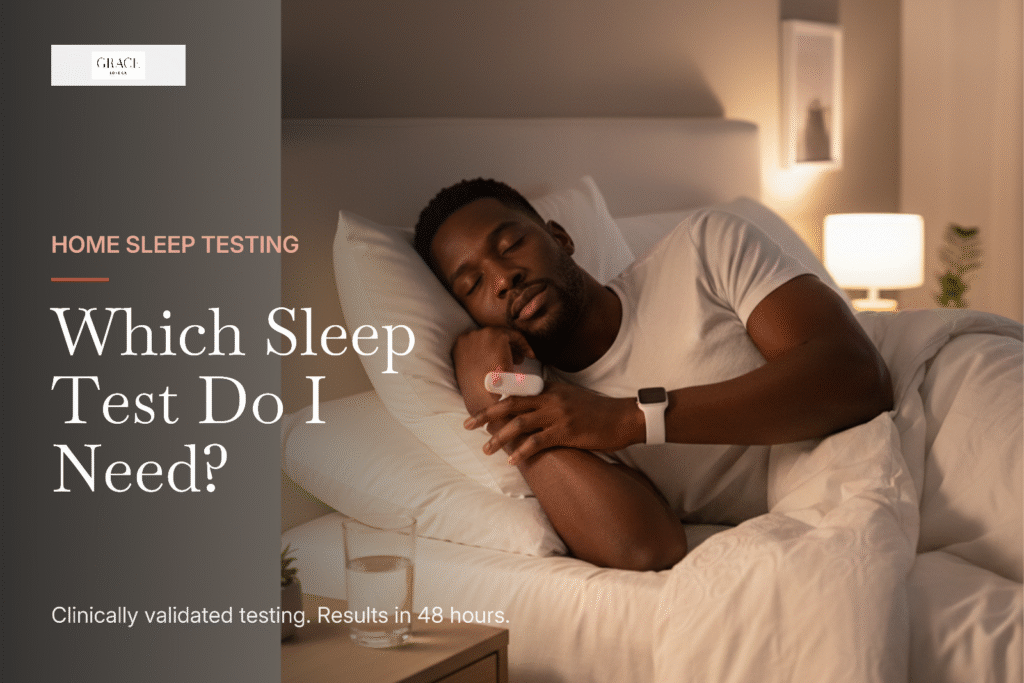
A Grace Sleep guide to the different types of sleep studies — and how we choose the right one for you
At Grace Sleep, our sleep questionnaires are designed to guide both you and our clinical team towards the most appropriate first test. If you have questions about our diagnostic process at any stage, our team is always available to help.
Many people know that sleep studies exist, but far fewer realise there are several different types of sleep test — each designed to answer a different clinical question.
Not everyone who snores needs the same level of investigation, and not everyone experiencing fatigue, insomnia, restless sleep, or excessive daytime sleepiness requires the most complex sleep study available.
At Grace Sleep, we take a personalised approach to sleep diagnostics. The goal is never to perform the most sophisticated test possible — it is to select the most appropriate investigation based on your symptoms, medical history, and clinical needs.
What Can a Sleep Study Diagnose?
Modern sleep testing allows us to investigate a wide range of conditions, including:
Snoring
Obstructive sleep apnoea
Restless legs syndrome
Periodic limb movement disorder
Insomnia
Parasomnias
Narcolepsy
Nocturnal epilepsy
Unexplained daytime sleepiness
Choosing the correct test helps us obtain meaningful diagnostic information, while keeping the experience as comfortable and convenient as possible.
The Grace Sleep Clinical Perspective
Sleep disorders are diverse. Some arise from breathing disturbances, others from movement disorders, circadian disruption, neurological conditions, or abnormalities in sleep architecture itself.
At Grace Sleep, we use a tiered diagnostic pathway. Most patients can be accurately assessed using simple home-based monitoring. More advanced investigations are reserved for situations where symptoms are complex, previous testing has been inconclusive, or there is concern about a less common sleep disorder.
Our philosophy is straightforward: begin with the least intrusive test capable of answering the clinical question, while ensuring more advanced diagnostics remain available whenever they are needed.
Tier One — AccuPebble Home Sleep Study
For many patients, the AccuPebble provides an excellent starting point. This compact, wearable home sleep monitoring device is designed to evaluate:
- Snoring
- Suspected obstructive sleep apnoea
- Sleep-disordered breathing
- General sleep screening
The device uses advanced acoustic and physiological monitoring to assess breathing patterns throughout the night and identify evidence of airway obstruction.
Typical Reasons We Recommend AccuPebble
- Habitual snoring
- Witnessed pauses in breathing
- Morning headaches
- Excessive daytime tiredness
- Unrefreshing sleep
- Screening for obstructive sleep apnoea
- Cardiovascular risk factors associated with possible sleep apnoea
For many individuals — particularly those whose symptoms relate primarily to snoring or suspected sleep apnoea — the AccuPebble provides sufficient information to establish a diagnosis and guide treatment. Its simplicity and ease of use make it an excellent first-line investigation.
Tier Two — S-MED Home Sleep Study
Some patients require more detailed physiological monitoring than a screening study alone can provide. In these situations, we may recommend the S-MED home sleep study.
The S-MED system offers a more comprehensive assessment of sleep-related breathing, and can also be configured with limb leads when clinically indicated — allowing us to investigate movement disorders during sleep as well as breathing disturbances.
S-MED Without Limb Leads
This option may be recommended when:
- Symptoms are suggestive of sleep apnoea but more detailed data is required
- Initial screening results are inconclusive
- Symptoms appear disproportionate to screening findings
- Additional physiological information is needed to guide treatment decisions
The additional monitoring provides greater diagnostic confidence and a more detailed understanding of sleep-related breathing patterns.
S-MED With Limb Leads
Adding limb leads allows us to assess movement of the arms and legs during sleep — particularly useful when there is concern about Restless Legs Syndrome or Periodic Limb Movement Disorder.
Restless Legs Syndrome (RLS)
A neurological condition characterised by:
- An urge to move the legs
- Uncomfortable sensations in the limbs
- Symptoms that worsen at rest
- Evening or night-time predominance
Periodic Limb Movement Disorder (PLMD)
Some individuals experience repetitive limb movements during sleep that may:
- Fragment sleep
- Reduce sleep quality
- Contribute to fatigue
- Cause unexplained daytime symptoms
Often, patients are entirely unaware these movements are occurring.
Common reasons we recommend S-MED with limb leads include:
- Restless sleep
- Frequent overnight awakenings
- Bed partner reports of kicking or twitching
- Unexplained fatigue
- Poor-quality sleep despite apparently normal breathing
Tier Three — In-Home Video Polysomnography
Video polysomnography (PSG) is considered the gold standard sleep investigation — the most comprehensive sleep study available, recording a wide range of physiological signals throughout the night.
Measurements typically include:
- Brainwave activity (EEG)
- Eye movements
- Muscle activity
- Breathing patterns
- Oxygen levels
- Heart rhythm
- Limb movements
- Body position
- Continuous video monitoring
Because it provides detailed information about sleep architecture and neurological activity, polysomnography can investigate conditions that simpler studies cannot reliably diagnose.
When Might We Recommend Polysomnography?
We typically reserve full PSG for situations where symptoms are more complex, or where previous investigations have not fully explained an individual’s presentation. Examples include:
Unexplained Daytime Sleepiness
Some patients experience profound daytime sleepiness despite normal sleep duration, minimal snoring, and negative sleep apnoea testing. In these situations, PSG can help identify rarer causes of excessive sleepiness.
Narcolepsy
Narcolepsy is a neurological sleep disorder characterised by excessive daytime sleepiness, sudden sleep attacks, disrupted night-time sleep, and occasionally cataplexy. Polysomnography forms an important part of the diagnostic pathway.
Idiopathic Hypersomnia
This condition causes excessive sleepiness despite apparently adequate sleep quantity. Diagnosis often requires the exclusion of other sleep disorders through comprehensive testing.
Parasomnias
Parasomnias are unusual behaviours occurring during sleep, including sleepwalking, sleep talking, confusional arousals, and REM sleep behaviour disorder. Video monitoring can be particularly valuable in distinguishing between different types of parasomnia.
Nocturnal Epilepsy
Some forms of epilepsy occur predominantly during sleep and can be difficult to distinguish from other nocturnal events. Video polysomnography allows simultaneous monitoring of behaviour, brain activity, and physiological responses — invaluable in establishing an accurate diagnosis.
Bruxism
Teeth grinding and jaw clenching during sleep can contribute to jaw pain, headaches, tooth wear, and sleep disruption. Polysomnography can provide a detailed assessment where clinically appropriate.
Why Not Use Polysomnography For Everyone?
Although polysomnography provides the most information, more data is not always better. Many patients with straightforward snoring or sleep apnoea can be accurately diagnosed using simpler home studies.
A tiered approach allows us to:
- Improve convenience
- Reduce unnecessary complexity
- Maintain diagnostic accuracy
- Reserve advanced investigations for cases where they are truly beneficial
The Grace Sleep Approach
At Grace Sleep, diagnostics are guided by specialist clinical assessment — never a one-size-fits-all model. Our sleep physicians consider:
- Symptoms
- Medical history
- Lifestyle factors
- Circadian rhythm
- Airway anatomy
- Neurological considerations
This allows us to select the most appropriate investigation and build a personalised pathway towards diagnosis and treatment.
Whether your symptoms relate to snoring, suspected sleep apnoea, restless sleep, insomnia, unexplained fatigue, or a more complex neurological sleep disorder, our aim is always the same — to identify the underlying cause of disrupted sleep and help you achieve deep recovery and sustainable energy.
Frequently Asked Questions
Which sleep test is best?
The best test depends on the symptoms being investigated. Many people only require a simple home sleep study, while more complex presentations may benefit from full polysomnography.
Can I do these tests at home?
Yes. All sleep studies offered by Grace Sleep are performed in the comfort of your own home.
Will I always need the most advanced sleep study?
No. Most patients can be accurately diagnosed using simpler investigations. More advanced testing is reserved for situations where additional information is needed.
Final Thoughts
Sleep studies are among the most powerful tools available in modern sleep medicine. They allow us to move beyond assumptions and understand exactly what is happening during sleep.
From simple snoring assessments to comprehensive neurological sleep investigations, selecting the right test provides clarity, reassurance, and a clear pathway towards effective treatment.
For many people, the journey towards better sleep begins with a single question: do we need to look more closely at what happens overnight? When the answer is yes, choosing the right sleep study is the first step towards finding lasting answers.
Book your sleep questionnaire with Grace Sleep today — our clinical team will recommend the right test for your symptoms. No referral needed. becomes more persistent and requires targeted intervention.